High-end AV equipment cannot overcome poor room acoustics. Excessive reverberation and low-frequency buildup critically degrade speech intelligibility in critical listening environments. You can install top-tier microphones and line-array speakers, but untreated hard surfaces will still ruin your audio clarity. Facility managers, architects, and AV integrators face a tough balancing act. They must weigh acoustic performance against strict fire compliance and architectural aesthetics. Furthermore, they must achieve these goals without compromising structural integrity.
This article provides a clear, evidence-based framework for evaluating a Grooved Acoustic Panel for commercial applications. We focus entirely on technical specifications, performance realities, and installation requirements. You will learn how precise grooving profiles mitigate resonance and why certain installation techniques drastically alter acoustic test results in the real world.
Key Takeaways
Grooved acoustic panels specifically target medium low frequency absorption, mitigating the "boominess" that degrades speech clarity in large volumes.
An NRC 0.7-0.9 rating represents the optimal balance of sound absorption and structural reflection, preventing a room from sounding artificially "dead."
Real-world performance depends heavily on implementation; mounting depth and cavity materials significantly alter the acoustic absorption curve.
Commercial specification requires verifying Class A fire ratings, environmental certifications (like FSC or low VOC), and structural mounting compatibility.
The Acoustic Challenge in Large Commercial Spaces
Conference Room Realities
Modern corporate architecture heavily favors glass walls, hard flooring, and massive boardroom tables. These highly reflective surfaces create severe acoustic anomalies. A poorly treated conference room inevitably suffers from flutter echoes. These rapid, repeating reflections occur between parallel hard walls. They distort incoming audio and frustrate remote participants during video calls. Additionally, standing waves build up in untreated corners. This creates uneven volume levels depending on where a listener sits.
Auditorium Dynamics
Large assembly spaces present entirely different acoustic hurdles. A massive auditorium inherently possesses a high ceiling volume. This expansive air space stores acoustic energy, leading to prolonged reverberation times (RT60). High RT60 values blur rapid syllables together. When a speaker talks, the lingering sound of previous words masks the current words. This phenomenon causes rapid listener fatigue. Without proper intervention, audiences struggle to comprehend basic spoken presentations.
To understand the scale of acoustic degradation in large volumes, we typically categorize the failures into three distinct phases:
Early Reflections: Sound waves bouncing off nearby surfaces within milliseconds, smearing the direct sound from the speaker.
Late Reverberation: Diffuse sound energy lingering in the upper volume of the room long after the source stops.
Low-Frequency Buildup: Bass frequencies pooling in structural corners, creating a muddy and overwhelming "boom" effect.
The Limitation of Standard Foam
Many facilities initially attempt to solve reverberation using traditional thin porous absorbers, such as standard acoustic foam. This approach usually fails in commercial environments. Thin foam only mitigates high-frequency energy. It leaves lower frequencies completely untreated. Consequently, the room loses its natural brightness but retains its muddy, unbalanced low end. Effective acoustic design requires targeting the specific frequency bands where human speech occurs.
The Engineering Behind Grooved Acoustic Panels
Mechanism of Action
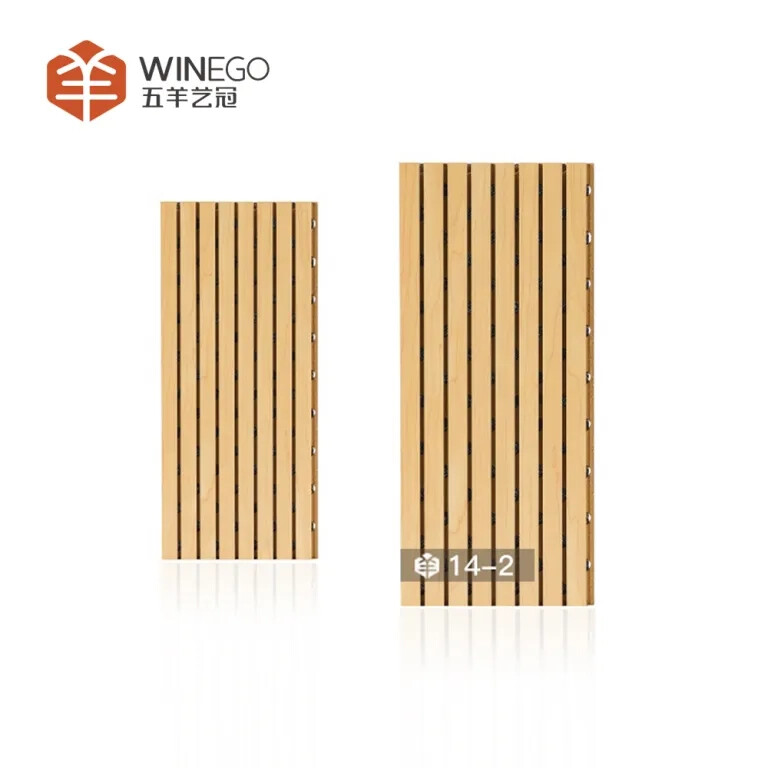
Grooved panels do not simply absorb sound through soft mass. They operate on the Helmholtz resonator principle. Manufacturers mill precise linear slots into the panel surface. Behind these narrow grooves sits a larger cavity, often filled with air or a fibrous backing. Sound waves enter the narrow grooves and immediately expand into the cavity behind. This sudden expansion creates air friction. The friction dissipates the problematic acoustic energy as harmless heat.
Medium Low Frequency Absorption
Unlike flat fabric-wrapped fiberglass, timber panels utilize specific geometric engineering. The exact width of the groove and the depth of the backing cavity determine the target frequency. Engineers design these dimensions to trap frequencies between 250Hz and 1000Hz. This specific range dictates medium low frequency absorption. This spectrum is critical because it contains the fundamental frequencies of human vowel sounds. It also encompasses the persistent hum of commercial HVAC systems.
Balanced Diffusion and Absorption
Acoustic treatment is rarely about eliminating all sound. The flat face of the solid wooden slats serves a vital purpose. It provides necessary high-frequency reflection. This reflection keeps the room sounding natural and live. If you apply too much broad-spectrum absorption, the space becomes oppressively quiet. Users often describe overly treated rooms as feeling "pressurized" or unnatural. Grooved panels strike a deliberate balance between scattering high notes and trapping muddy lows.
Acoustic Treatment Material Comparison Table
Material Type | Primary Frequency Target | Aesthetic Value | Durability |
Standard Open-Cell Foam | High Frequencies (>2000Hz) | Low (Utilitarian) | Low (Tears easily, degrades) |
Fabric-Wrapped Fiberglass | Broadband (Mid to High) | Medium (Corporate standard) | Medium (Fabric can snag or stain) |
Grooved Wood Panels | Medium-Low (250Hz - 1000Hz) | High (Architectural veneer) | High (Impact resistant MDF core) |
Evaluating Performance Metrics: NRC 0.7-0.9
Understanding NRC in Context
The Noise Reduction Coefficient (NRC) serves as the industry standard for rating acoustic materials. It is a mathematical average of sound absorption across four specific mid-range frequencies: 250, 500, 1000, and 2000 Hz. An NRC of 0.80 suggests the material absorbs roughly 80% of sound energy across those bands. However, NRC represents a simplified baseline metric. It is not a complete acoustic profile. Two panels can share an identical NRC but perform differently at 250Hz versus 2000Hz.
Why NRC 0.7-0.9 is the Target
Acoustic engineers generally specify an NRC 0.7-0.9 rating for large public spaces. This range indicates 70% to 90% of sound energy absorption. It represents the architectural sweet spot for large meeting rooms or presentation halls. This performance level provides robust reverberation control without requiring wall-to-wall coverage. It allows designers to leave portions of drywall or glass exposed for aesthetic reasons while still meeting the required RT60 targets.
Reading Absorption Coefficients
Smart specification requires looking past the single-number rating. Buyers should always request independent laboratory testing data. Look for reports adhering to standardized protocols like ASTM C423 or ISO 354. You must verify the absorption curve across the entire frequency spectrum.
Typical Absorption Curve Chart (Targeting NRC 0.8)
Frequency (Hz) | 125 | 250 | 500 | 1000 | 2000 | 4000 |
Absorption Coefficient | 0.35 | 0.65 | 0.95 | 1.05 | 0.75 | 0.60 |
Note: Coefficients can exceed 1.0 due to diffraction effects at the edges of the tested material sample. Notice the peak efficiency at 500Hz and 1000Hz.
Specification Criteria: Material, Compliance, and Aesthetics
Fire Safety Compliance
Commercial environments mandate strict adherence to local life-safety codes. You must demand essential verification of Class A (or Euroclass B) fire ratings. This compliance cannot be an afterthought. Crucially, the fire rating must apply to the entire panel system. Some manufacturers use a Class A surface veneer over a non-rated core. In public assembly spaces, inspectors will reject this. Ensure the acoustic core material, the adhesive, and the facing all meet rigorous flame spread and smoke development limits.
Environmental and Health Standards
Indoor air quality significantly impacts occupant well-being in enclosed, high-occupancy spaces. Your shortlisting criteria must prioritize environmental certifications.
Formaldehyde-Free MDF: Demand No Added Formaldehyde (NAF) cores to prevent toxic off-gassing over time.
Low-VOC Finishes: Ensure surface lacquers and acoustic backing felts do not emit volatile organic compounds.
Sustainable Sourcing: Look for Forest Stewardship Council (FSC) certification to guarantee responsible timber harvesting.
Durability and Maintenance
Acoustic treatments must survive their environment. Assess the intended placement before specifying the exact panel type. High-traffic corridors require superior impact resistance. A misplaced equipment cart can easily shatter a fragile porous panel. Conversely, out-of-reach ceilings face zero impact risks but demand long-term structural stability to prevent sagging. Maintenance teams must also find the panels easy to clean. Grooved geometries should allow standard vacuuming without snagging or degrading the acoustic felt trapped inside the slots.
Implementation Realities and Installation Risks
The Air Gap Variable
Acoustic performance does not exist in a vacuum. It depends entirely on the physical installation. The stated NRC rating is highly dependent on mounting depth. Direct-to-drywall application (known as Type A mounting) yields significantly lower bass absorption. The Helmholtz resonator needs volume to work. Mounting panels on furring strips creates an air gap (Type E-400 mounting). Filling this new cavity with rigid fiberglass or mineral wool drastically improves the low-frequency absorption curve. If you ignore the air gap, you will miss your acoustic targets.
Alignment and Seaming
Visual aesthetics demand rigorous installation standards. Continuous groove alignment across large walls requires precise tolerances. High-end panels feature tongue-and-groove edges to help installers maintain spacing. However, framing walls are rarely perfectly plumb. Installers must constantly shim and adjust the furring strips. A single millimeter of misalignment ruins the desired monolithic visual effect. The slots must flow seamlessly from floor to ceiling.
Integration with Infrastructure
Commercial walls carry extensive infrastructure. You must plan for necessary cutouts around MEP (mechanical, electrical, plumbing) fixtures.
Fire sprinklers and strobes require careful circular boring.
HVAC diffusers must sit flush against the slat surface.
AV integration, including display mounts and recessed speakers, needs heavy structural blocking behind the acoustic core.
Cutting through the panel compromises its local acoustic integrity. Contractors must seal exposed edges to prevent core moisture absorption and maintain fire safety ratings.
Shortlisting Next Steps
Protect your project timeline by actively managing the specification phase. Request physical samples immediately to verify veneer quality and groove finish. You must review third-party acoustic test reports based strictly on your specific mounting type. A lab test for a panel suspended 400mm off a ceiling does not apply to a panel glued directly to a concrete wall. Finally, consult with a specialized acoustic contractor early. They can spot framing issues and integration conflicts long before materials arrive on site.
Conclusion
A high-quality grooved acoustic panel is a calculated engineering choice. It resolves difficult resonance issues while maintaining high-end architectural standards. You cannot fix bad room geometry with better speakers; you must address the physical environment. By targeting the human vocal spectrum, these specific wood profiles ensure exceptional speech clarity.
Base your purchasing decisions entirely on verified laboratory data. Ensure this data matches your intended installation method. Verify that the system meets both your acoustic target and your local life-safety codes. Do not rely on single-number ratings without viewing the full frequency curve.
Consult with an acoustic engineer to determine the exact square footage required. Strategic placement matters just as much as overall volume. They will help you calculate the precise panel distribution needed to achieve your target RT60.
FAQ
Q: What is the difference between grooved acoustic panels and perforated panels?
A: Grooved panels use linear slots and are highly effective for medium-low frequencies while offering a slatted wood aesthetic. Perforated panels use round or square holes and often provide a broader, but sometimes less targeted, absorption curve depending on the open-area percentage.
Q: Can a grooved acoustic panel achieve an NRC higher than 0.9?
A: Yes, but typically only when installed with a significant air cavity and secondary absorptive backing (like 2-inch mineral wool). Direct mounting rarely exceeds NRC 0.8.
Q: Are these panels suitable for curved auditorium walls?
A: Rigid MDF panels require specific manufacturing (kerfing) to bend. Flexible grooved options exist but must be specified early in the design phase to accommodate the radius of the curve.
Q: How do I clean grooved acoustic panels in a commercial setting?
A: Routine maintenance involves dusting with a soft brush attachment on a vacuum cleaner. Liquid cleaners should be avoided to prevent damaging the wood veneer or the acoustic felt backing.