Large-scale commercial spaces and auditoriums face a fundamental acoustic challenge. They must balance crisp vocal intelligibility against natural acoustic energy. You cannot afford muddled speech during a keynote, nor can you tolerate overwhelming echoes during a premium musical performance.
Relying entirely on absorption panels creates a massive risk for any venue. It strips away vital frequencies, leaving you trapped in an over-deadened, lifeless room. Sound diffusion serves as the critical mechanism to solve this problem. It preserves necessary spatial depth while completely eliminating harsh slapback flutter echoes.
This guide offers a comprehensive technical evaluation framework. Architects, facility managers, and AV integrators will learn how to properly specify panel systems. You will discover exactly how to evaluate materials, understand architectural dispersion, and transform your venue into a pristine auditory environment.
Key Takeaways
Absorption reduces acoustic energy; diffusion scatters it to maintain a "live" but controlled acoustic environment.
QRD sound diffusers (1D) and Skyline diffusers (2D) serve different spatial functions and require precise mathematical sequencing (not random aesthetics) to function across broadband frequencies.
Material density dictates performance: a wood acoustic diffuser for auditorium applications imparts natural tonal warmth, whereas lightweight foam acts as an ineffective imposter.
Maximum ROI requires a hybrid approach, strategically combining diffusers with Wood Slat Acoustic Panels or bass traps.
The Auditorium Dilemma: Why Complete Sound Absorption Fails
Applying sound absorption materials to every available surface drastically degrades the audience experience. When you cover a room in porous foam or thick fabric, you create an unnaturally "dead" acoustic environment. The room loses its natural reverberance. Performers struggle to hear themselves on stage, and audiences in the back rows experience a flattened, lifeless soundstage. This business problem frequently plagues newly built auditoriums where designers prioritize noise reduction over acoustic vitality.
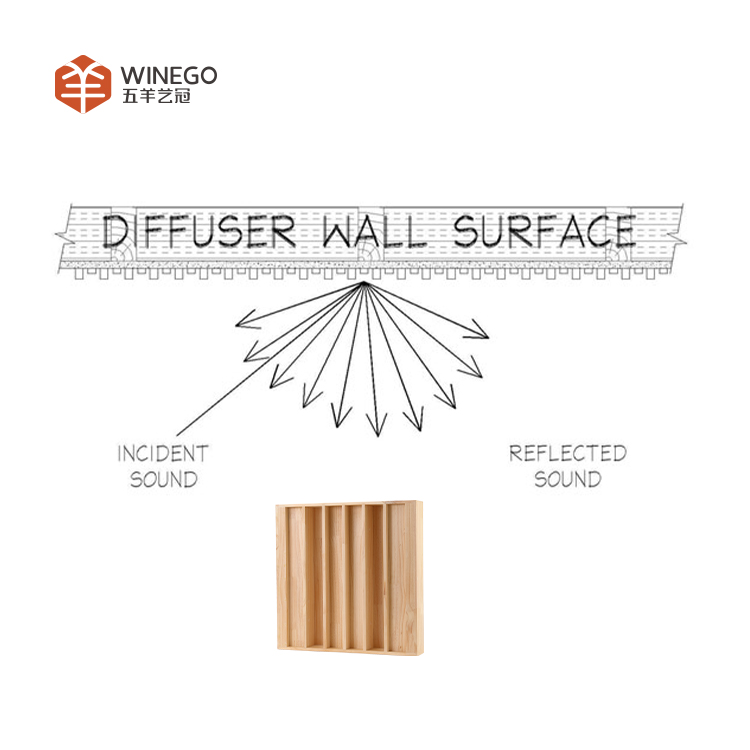
Understanding the science of diffusion requires a simple optical analogy. Imagine a dark room where the walls absorb all incoming light. An absorption panel acts just like a black wall. It stops energy from returning to the room. Conversely, a high-quality acoustic diffuser panel functions like a finely faceted mirror. It takes a single beam of bright light and scatters it evenly across the space. It eliminates blinding glare—the harsh acoustic echoes—without dimming the overall brightness of the room. It preserves the vital acoustic energy you need to keep performances dynamic.
A successful acoustic treatment in an auditorium must meet very specific criteria. You cannot rely on guesswork. We define success by how well the venue adapts to different auditory demands.
Elimination of Specular Reflections: The treatment must break up harsh echoes bounding between parallel walls.
Retention of High Frequencies: The room must maintain the "air" and brilliance required for orchestral performances.
Speech Intelligibility: The space must deliver clear, uncolored consonants for theatrical plays and dynamic keynote speeches.
Even Sound Distribution: Every seat in the house must receive a balanced frequency response, free from localized dead zones.
QRD Sound Diffuser vs. Skyline Diffuser: Selecting the Right Architecture
You must select the correct diffuser architecture to address your specific spatial anomalies. The industry generally categorizes advanced diffusers into two distinct mathematical models. Each serves a very different purpose in an auditorium setting.
Solution Categories & Technical Breakdown
First, we look at the Quadratic Residue Diffuser. Acoustic engineers commonly refer to this as a 1D dispersion tool. It utilizes a series of parallel, symmetric mathematical wells of varying depths. A QRD sound diffuser takes incoming sound waves and scatters them in a single plane, usually horizontally. It breaks up direct reflections while keeping the acoustic energy locked in the listener's horizontal plane. You will find this architecture best applied on rear walls and side walls at primary reflection points. It dramatically widens the perceived soundstage, making the room sound much larger than its physical dimensions.
Second, we have Skyline diffusers, technically known as Primitive Root Diffusers (PRD). This represents a 2D dispersion tool. It relies on a grid of asymmetric blocks cut to varying, mathematically determined heights. Instead of scattering sound in one direction, a Skyline diffuser scatters sound hemispherically. It pushes acoustic energy up, down, left, and right simultaneously. You should place these units directly above the sound source or the audience. Suspending them as a highly functional Ceiling Cloud effectively breaks up destructive vertical standing waves between the floor and the roof.
Decision Matrix
Guide your procurement process by analyzing the specific architectural geometry of your targeted listening zones. The following comparison chart clarifies exactly when to deploy each solution.
Feature | 1D QRD System | 2D Skyline (PRD) System |
Dispersion Pattern | Single plane (Horizontal or Vertical) | Hemispherical (Multi-directional) |
Underlying Math | Quadratic Residue Sequences | Primitive Root Algorithms |
Ideal Placement | Rear walls, lateral side walls | Ceilings, directly above stage or mix positions |
Primary Function | Widening the soundstage, preventing flutter echo | Eliminating vertical standing waves, overall room decay control |
Listener Distance | Requires moderate distance to form wave | Highly effective for closer proximity overhead |
When you evaluate features relative to acoustic outcomes, material density becomes your most critical metric. Sound behaves very much like water; it takes on the characteristics of the surface it strikes. If sound hits a cheap, hollow plastic surface, it reflects back with a brittle, synthetic tonality. If it strikes a dense, resonant surface, it returns with warmth and clarity.
We must aggressively debunk the "foam diffuser" myth. You will frequently see lightweight acoustic foam molded into jagged, blocky shapes marketed as diffusers. This represents a dangerous industry trap. Lightweight foam simply lacks the physical mass necessary to reflect sound waves. Foam absorbs narrow, high-frequency bands. It does not diffuse them. Using foam "diffusers" in a large venue will instantly strip away vocal clarity while doing absolutely nothing to manage mid-range echoes.
You gain a massive acoustic advantage when utilizing natural timber. A solid wood acoustic diffuser for auditorium environments acts like a beautifully crafted acoustic instrument. Premium materials like cherry, alder, or ultra-dense MDF possess the exact specific gravity needed to cleanly reflect sound. They handle heavy acoustic loads without introducing the resonant rattling or brittle degradation caused by cheap plastics and hollow composites. Hardwoods impart a smooth, natural decay to the reverberation tail, elevating the prestige of the venue's sound profile.
Commercial installations also require strict adherence to building codes. Synthetic foams pose severe fire hazards and often emit volatile organic compounds over time. Conversely, commercial-grade wood installations can undergo specialized treatments to meet strict Class A fire-safety regulations. They ensure decades of structural durability, resisting physical impacts in high-traffic public venues while maintaining their visual and acoustic integrity.
Engineering Precision vs. Visual Aesthetics: Mitigating Implementation Risks
Many projects fail because designers prioritize visual aesthetics over hard acoustic physics. You must recognize the severe implementation realities of treating a large space. A "pseudo-random" DIY panel or a visually driven wooden art piece lacks the underlying mathematics required to manipulate sound effectively.
The Importance of Prime Number Algorithms
True broadband diffusion relies entirely on precise depth calculations based on prime numbers. When sound waves enter the wells of a diffuser, they exit at different times, creating a phase-shifted reflection. If a manufacturer builds a panel solely for looks—using randomized blocks with minimal height variation—the panel will fail completely. It might scatter a tiny fraction of extreme high frequencies, but it will completely ignore the vital mid-range frequencies where human speech and instrumental fundamentals reside. You need mathematically rigorous sequences to ensure smooth, predictable scattering across a wide bandwidth.
The Comb Filtering Risk
You must strictly observe installation distance rules. This represents one of the most critical factors in acoustic design. If you place diffusers too close to the audience, the scattered sound waves do not have enough physical space to fully integrate. This proximity causes phase interference, leading to a destructive phenomenon known as comb filtering. Comb filtering creates a hollow, metallic "phasing" sound that ruins the listening experience. As a general rule, listeners should sit at least 3 to 6 feet away from any deep diffusion panel. You must factor this seating buffer into your architectural floor plan.
Verification and Best Practices
We urge buyers to demand hard data. Never rely on visual design alone when specifying acoustic products.
Ask for Sabine Coefficients: Request laboratory testing data that proves the scattering coefficients across the 250Hz to 4000Hz spectrum.
Avoid Shallow Wells: Be wary of panels thinner than two inches. Shallow wells cannot affect mid-to-low frequencies.
Consult the Math: Verify the manufacturer uses recognized QRD or PRD sequences rather than arbitrary aesthetic patterns.
Building the Acoustic Ecosystem: Integrating Panels for Maximum ROI
You cannot fix every acoustic anomaly with a single product category. Structuring your acoustic procurement requires a holistic mindset. Decision-makers must understand shortlisting logic. A standalone diffusion panel works wonders for mid-to-high frequency scattering, but it cannot fix low-frequency bass issues or excessive overall reverberation times. Long waveforms require thick, dedicated absorption.
Hybrid Ecosystem Design
You will achieve the best auditory results by engineering a hybrid acoustic ecosystem. You must deploy specific panels to tackle specific zones within the room.
Manage the Rear Boundaries: Use QRD panels on the rear walls facing the stage. This prevents sound from slapping off the back wall and rushing back to the performers as a delayed, confusing echo.
Control the Lateral Reflections: Deploy Wood Slat Acoustic Panels on the lateral side walls. These hybrid panels offer a brilliant mix of mid-high frequency absorption and gentle scattering. They tighten up speech clarity for audience members seated near the aisles.
Tame the Stage Environment: Install a dense Grooved Acoustic Panel system near the stage boundaries and proscenium. This mitigates early localized reflections right at the sound source, preventing microphone feedback while keeping the performers' monitors clear.
Anchor the Corners: Place dedicated, high-density bass traps in the structural corners of the auditorium to absorb muddy, low-frequency buildup.
Commercial Success Metrics
Investing in a balanced acoustic treatment ecosystem yields tremendous commercial benefits. You prevent costly, embarrassing post-construction retrofits by doing the math correctly from day one. An acoustically flawless room drastically improves audience satisfaction, leading to better reviews and stronger ticket sales. Most importantly, a meticulously engineered hybrid space increases the venue's overall capability. You can seamlessly transition from hosting an unamplified classical orchestra on a Friday to a heavily amplified corporate keynote on a Monday, confidently knowing the room handles both acoustic loads perfectly.
Conclusion
Achieving pristine sound clarity in an auditorium is strictly an exercise in applied mathematics and advanced material science. You cannot guess your way to a great-sounding room. Proper diffusion breaks up destructive echoes without robbing your venue of its natural, exciting acoustic energy.
Your next steps should focus on precision planning. Conduct a comprehensive acoustic audit of your space using specialized software to measure exact reverberation times. Map out your primary reflection points precisely. Finally, consult with a structural acoustic engineer or a specialized supplier to specify the exact ratio of diffusion to absorption your auditorium needs to thrive.
FAQ
Q: What is the difference between an acoustic diffuser and an absorber?
A: An absorber acts like a sponge, reducing the overall volume and reverberation time by converting sound energy into heat. A diffuser acts like a shattered mirror. It does not reduce the acoustic energy in the room. Instead, it scatters the sound waves into multiple directions to retain spatial depth, maintain clarity, and eliminate harsh, repeating echoes.
Q: Can you use a QRD sound diffuser in a small room?
A: Yes, you can use them in small rooms, but you must exercise caution. Because QRD panels rely on phase-shifted reflections, the listener must be seated far enough away (usually at least 3 to 6 feet). This distance allows the scattered sound waves to physically integrate. Sitting too close causes phase cancellation and comb filtering.
Q: Where is the best place to install a Skyline diffuser?
A: The optimal placement for a Skyline (2D) diffuser is on the ceiling. Often integrated into a suspended ceiling cloud, it perfectly breaks up vertical standing waves bouncing between the floor and the roof. You can also place them on rear walls to disperse multi-directional sound anomalies and create a sense of vast space.
Q: Do wood diffusers handle low-frequency bass?
A: No. Wood diffusers face strict physical limits dictated by wavelengths. Low-frequency bass waves are often several feet long, allowing them to easily wrap around standard diffuser wells without scattering. To handle low frequencies effectively, you must utilize thick, dedicated bass traps installed in the structural corners of the room.